
Critical AI literacy at the scale of a university
Since 2024, most of my service has gone to Widener's response to generative AI. I chair the LEAD-AI Council, I'm the Provost's Special Advisor for AI Strategy, and I teach courses where AI is sometimes the subject and sometimes the sparring partner.
Why bother
Left alone, AI adoption widens the gap between students who arrive with advantages and students who don't. A student who has used these systems since high school and one meeting them for the first time in a college classroom are not in the same course, whatever the roster says.
So the goal isn't to ban the tools or to cheerlead for them. It's student success: every Widener graduate, at every level, leaves with a firm baseline of critical AI literacy. That means critical AI literacy everywhere in the curriculum, not just in a philosophy elective that the already-curious sign up for.
Our AI strategy
The aim is student success
Every Widener graduate, at every level, leaves with a firm baseline of critical AI literacy: prepared to use these tools effectively and ethically in their chosen field, to navigate a world infused with AI, and to make sure that world stays human-centered.
Build it in
Critical AI literacy pathways across the curriculum, both general and discipline-specific.
Protect the core
Name the fundamental skills that students have to build without AI's help, and protect them in every program.
Bring learning to light
Rethink courses, outcomes, and assessment so that students' growth is something we can see and verify.
The foundation is faculty. Faculty decide what critical AI literacy means in their fields and how it gets built. Everything below exists to support that.
Start here
Three front doors. Everything else, from the survey reports to the AI Sparks lineup, is linked from inside these.
AI Working Group
The team, the work, and the student, faculty, and staff survey reports.
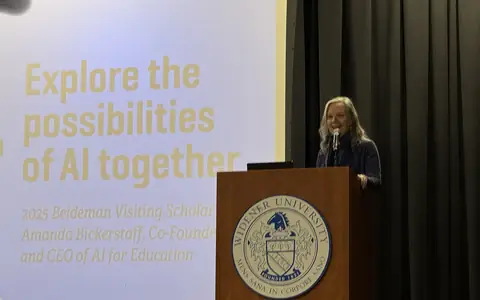
March 21, 2025AI Day
Our first university-wide AI event, with 800+ people. What happened, and what the papers said about it.
March 2–5, 2026AI Week
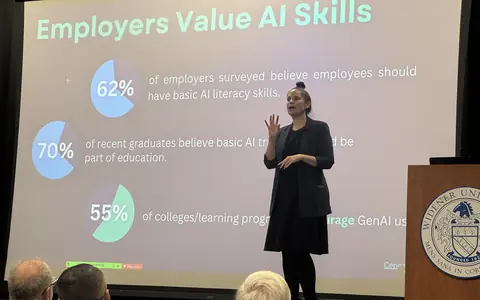
AI Day, grown into four days: lightning talks, productivity shares, a student poster show, and a forum with the trustees. Next up: AI Week 2027, March 16–19.
How it's organized
What started as a seven-person working group is now the core of Widener's academic AI governance. The design principle is in the name of our AAC&U talk: every voice in the room.
LEAD-AI Council
Sets university AI strategy and reports to the President's Leadership Team.
BRIDGE-AI Network
All seven schools and colleges, key offices, and student government. Where strategy meets the people who carry it out.
AI Faculty Fellows
One from every school and college, leading their unit's conversation about critical AI literacy in the curriculum. Recommendations go through faculty governance. Launches Spring 2027.
The day-to-day work is less glamorous and more useful. I wrote Widener's Critical AI Literacy Framework, with facilitation materials so faculty in nursing, engineering, and business can teach it without a philosophy degree. I also designed the AI Syllabus Statement Tool, led the BoodleBox rollout, and edit the AI at Widener site.
The Title III grant that I helped write ($2,911,907, funded in full) supports retention and graduation for Pell-eligible and first-generation students, and funds my appointment as Director of AI Curriculum Integration.
From a ChatGPT panel to a governance structure
- 2023First panels on ChatGPT and AI in the classroom. Everybody had questions.
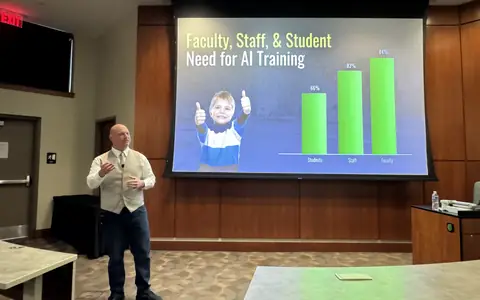
- 2024–25AAC&U Institute on AI, Pedagogy, and the Curriculum, co-chaired with then-Provost Andy Workman. Campus-wide surveys and trainings on all three campuses.
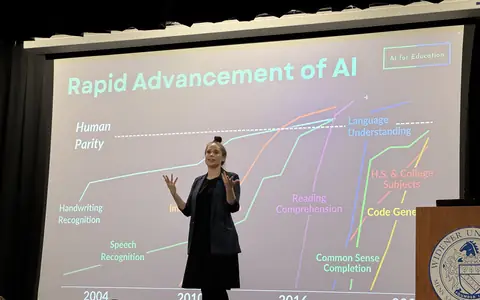
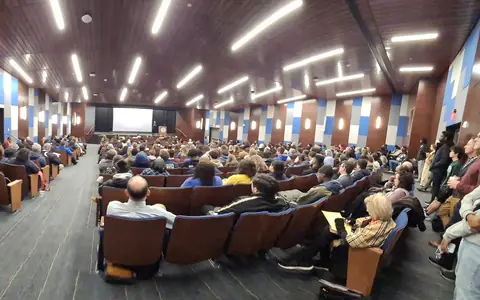
- Mar 2025AI Day: 800+ participants, including 500 students and members of the Board of Trustees.
- 2025–26Second Institute cycle, which I chaired. The Working Group becomes the LEAD-AI Council.
- Mar 2026AI Week, where students told faculty, administrators, and trustees what they actually think.
- 2026Special Advisor to the Provost; Title III funded; "Every Voice in the Room" at AAC&U's first Conference on AI and Higher Education.
- 2027AI Faculty Fellows launch in the spring. AI Week 2027: Show Your Work, March 16–19: faculty sessions on teaching, student work, and what the curriculum must protect.
Talks and workshops on AI are on the CV.
In the classroom
I'd rather design assignments that make cheating pointless than spend the semester trying to catch it. Some of them use AI on purpose.
The oral exam, and its sparring partner
Eight minutes alone with me and a case you haven't seen. What does justice require here? What's the strongest objection? Here's a fact you didn't have: does your answer change? Students practice first with an AI that refuses to give them a position.
Dorm Room Ponderer
Students explained counterintuitive physics to a chatbot that kept pushing back until their explanations got better. It was very annoying, on purpose.
How do you know I'm not AI pretending to be human?
Co-taught with a robotics engineer. He keeps my questions from floating off into the abstract; I keep his machinery from having nothing at stake.
Socratic bots, a Chinese Room, and a smart campus
Chatbots that teach Cartesian skepticism by asking, a classroom Chinese Room where students play the room, and a campus app built first for surveillance capitalism, then for students.
The course designs behind these are on the Teaching page. My research on AI, about authority without standing, is on the Research page.