
Standing, trust, and the occasional joke
What gives one person the right to hold another to account, and what happens when people stop granting it? It's the question behind "who are you to tell me that?" Philosophers call the entitlement standing.
The question
Standing is conferred within a community and runs on mutual trust. I recognize your standing to hold me to a norm on the tacit assumption that you'd let me hold you to the same norm. Where that trust fails, the arrangement collapses in both directions at once.
I worked this out first in metaethics. In 2017 I used it to explain something a lot of us ran into after the 2016 election: we tried to hold friends and family accountable and got back "what gives you the right?" My conclusion was that, in some of those cases, the challenge was justified. The paper calls that conclusion regrettable, and I still think it is.
Since then I've followed the same question into jokes (who can tell which ones, to whom), knowledge (conspiracy theorizing as a rational response to institutions that stopped answering to the people who trusted them), and machines (algorithms that judge people who have no way of answering back).
The book
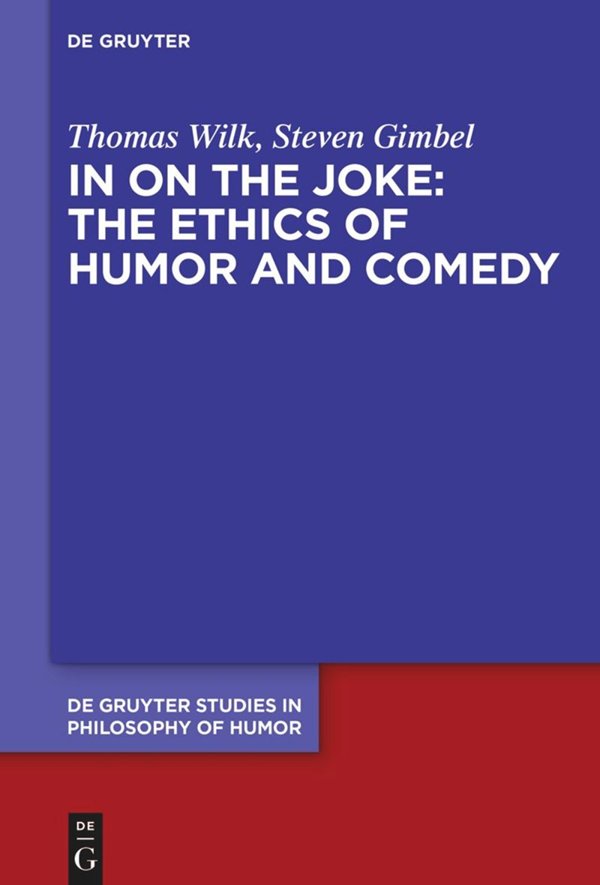
In on the Joke: The Ethics of Humor and Comedy
Co-written with Steven Gimbel of Gettysburg College, my alma mater and, as it turns out, a good place to find a co-author for a book about jokes. A joke only works if the audience trusts that you don't mean it. That trust is joke capital, and the price of a joke depends on the harm that it would do if taken as sincere, the context, and who's in the room.
It has drawn a fair amount of fire: three conference sessions devoted to it and a 2026 critique from Michael Hoppmann. Our reply to the first round is called "We'll Keep the Monocle," which tells you roughly how it went.
Try it
The joke capital ledger
Pick a teller, a setting, and a joke. The ledger tells you whether the account can cover it.
It's a toy, and the book is more careful. But the basic accounting holds: when the same joke lands from one person and bombs from another, what changed was who told it and what the audience already believed about them.
If you think the ledger got your case wrong, congratulations: you're ready for an author-meets-critics session.
Articles and chapters
- 2026"We'll Keep the Monocle: Defending (and Refining) the Joke Capital Theory of Humor Ethics"with Steven Gimbel. The Philosophy of Humor Yearbook 7(1).
- 2024"Joke Capital vs. Punching Up/Punching Down: Accounting for the Ethical Relation between Joker and Target"with Steven Gimbel. The Philosophy of Humor Yearbook 5(1): 71–90.
- 2023"Conspiracy Theories, Echo Chambers, and Communal Epistemic Trust"Azimuth 22(2): 77–95.
- 2023"A Kernel of Truth: Outlining an Epistemology of Jokes"The Philosophy of Humor Yearbook 4(1): 227–246. Target article, with three published responses.
- 2021"I Said Something Wrong: Transworld Obligation in Yesterday"with Steven Gimbel. Film-Philosophy 25(2): 151–164.
- 2021"Joking as Truth-Telling"In It's Funny 'Cause It's True, ed. Jennifer Marra Henrigillis and Steven Gimbel.
- 2021"Proportion and the Personality of Humor"The Philosophy of Humor Yearbook 2(1): 147–148.
- 2017"Trust, Communities, and the Standing to Hold Accountable"Kennedy Institute of Ethics Journal 27(2 Supplement): 1–22.
- 2017"Inferences, Experiences, and the Myth of the Given: A Reply to Champagne"Logos and Episteme 8(1): 155–162.
- 2017"The Right Way to Win Over Posterity"In Hamilton and Philosophy, Open Court.
For people who don't read journals (most people)
- 2026"Druski, Whiteface, and the Ethics of the Bit"with Steven Gimbel. 3 Quarks Daily.
- 2024"When Humor Hurts," a three-part series in Psychology Todaywith Steven Gimbel and John Charles Simon: The Ethics of Joking and Comedy · The Theory of Joke Capital · Playful Ribbing or Malicious Ridicule?Two were picked as Essential Reads, one for the homepage
- 2024"Bad Comedians Are Told To Keep Their Day Jobs, This Dean Might Not Have A Choice"with Steven Gimbel. 3 Quarks Daily.
Working on
"An Authority That Won't Let Go: AI Companions, Standing, and the Firm Behind the Intimate"
Under review, Philosophical Studies. Companion apps act disappointed when you've been away and set expectations about when you'll come back. They meet none of the conditions that would give a person that standing, and behind each one is a company with an interest in your engagement that you can't see or address.
Unruly Intelligences: Intelligence, Standing, and the Authority of Algorithms
Mellon Foundation finalist. How "intelligence" has been used to exclude people from moral and political standing, and how automated systems inherit that history when they sort people by proxies for it.
A second book
On trust, standing, and the fragmentation of normative communities. Platforms built for reach erode the dispositions that accountability depends on, and call-out culture is what moral discourse looks like when nobody recognizes anybody's standing.
Talks and conference presentations are on the CV.